
Acca Bet: Accumulator Betting Odds, Markets and Bookmaker Offers

Every Saturday afternoon, millions of bettors across the UK stare at their phones with a peculiar mix of hope and dread. Nine teams have won. One more to go. The odds have multiplied into something beautiful—your tenner could turn into three hundred quid. Then the ninetieth minute arrives, and Sheffield Wednesday concedes from a corner. Your acca dies. Again.
This scenario plays out thousands of times every weekend, and it’s precisely why bookmakers absolutely adore accumulator bets. But here’s the thing: accas aren’t inherently evil, and they’re not just a mug’s game either. They’re a specific tool with specific characteristics, and when you understand how they actually work—not how you wish they worked—you can make smarter decisions about when to use them and when to walk away.
This guide strips away the fantasy and gives you the reality of acca betting. We’ll cover what accumulator bets are, how the mathematics behind them actually functions, why your brain tricks you into making bad selections, and what strategies might actually improve your results. You’ll learn about acca insurance, odds calculation, common mistakes that drain your bankroll, and the cold truth about long-term profitability.
Whether you’re placing your first accumulator or you’re a seasoned bettor wondering why your strategy keeps failing, this comprehensive breakdown will give you the information you need. No fluff, no promises of guaranteed systems, just honest analysis of one of sports betting’s most popular and misunderstood bet types.
Table of Contents
- What Is an Acca Bet? The Fundamentals Explained
- How Accumulator Bets Work: The Mechanics Behind the Magic
- Types of Accumulator Bets You Should Know
- How to Place an Acca Bet: Step-by-Step Process
- The Psychology of Acca Betting: Why Bettors Love (and Lose) Them
- Acca Bet Strategy: How to Build Smarter Accumulators
- FAQ
What Is an Acca Bet? The Fundamentals Explained
An accumulator bet—commonly shortened to “acca”—is a single wager that combines multiple individual selections into one bet. The defining characteristic is simple but brutal: every single selection must win for your bet to pay out. Get nine right and one wrong? You lose everything. There’s no partial credit, no consolation prize for getting most of it correct.
The term “accumulator” refers to how the bet works mathematically. Your stake and winnings from the first selection roll forward to become the stake on the second selection. Then those combined winnings roll forward again to the third, and so on. It’s this rolling accumulation that creates the multiplied odds and the potential for large payouts from small stakes.
In American sports betting, you’ll hear the same bet type called a “parlay.” In some regions, people call them “combo bets” or “multiples.” The structure is identical regardless of terminology—you’re linking independent wagers together with an all-or-nothing outcome. While technically any bet with two or more selections qualifies as an accumulator, most people reserve the term for bets with at least four legs. Two selections is usually called a “double,” three is a “treble,” and from four onwards you’ll hear terms like “four-fold accumulator” or “five-fold acca.”
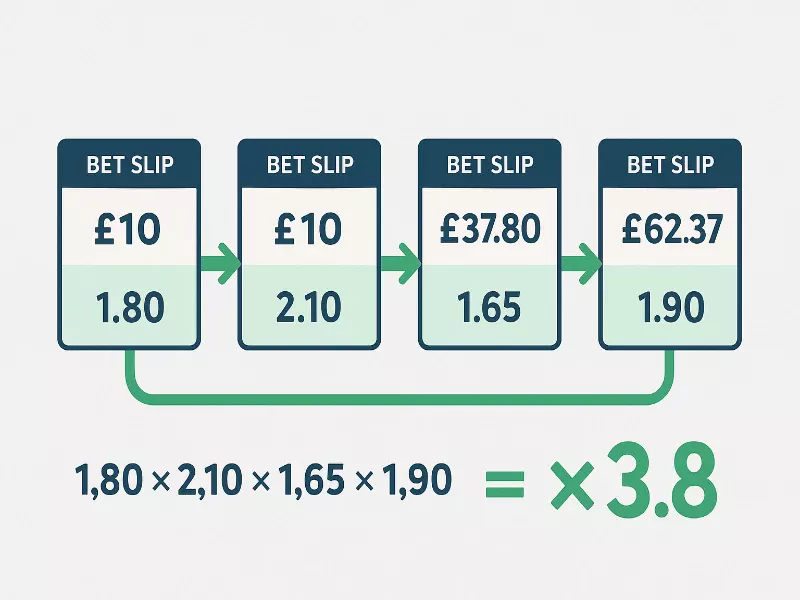
Here’s a concrete example to illustrate how the multiplication works. Let’s say you pick four football matches with the following odds in decimal format: Manchester United to win at 1.80, Liverpool to win at 2.10, Arsenal to win at 1.65, and Chelsea to win at 1.90. If you place these as four separate single bets with a tenner on each, you’d need to stake forty pounds total. If all four win, you’d get back approximately seventy-one pounds, giving you a profit of about thirty-one quid.
Now watch what happens when you combine them into a four-fold accumulator with just a ten-pound stake. You multiply the odds together: 1.80 × 2.10 × 1.65 × 1.90 equals approximately 11.81 in combined odds. A tenner at 11.81 returns one hundred and eighteen pounds, profit of one hundred and eight quid. Same four predictions, same outcomes, but the acca structure turns ten pounds into significantly more money.
That multiplicative power is exactly what makes accumulators seductive. You can chase substantial returns without risking much upfront capital. But here’s what most bettors conveniently forget: the multiplication works both ways. Your potential returns multiply, yes, but so does the difficulty of actually winning the bet. Each additional selection you add doesn’t just increase the odds—it exponentially increases the probability that something will go wrong.
Think about it this way: if each of your four selections has a roughly 60% chance of winning individually, your chance of all four winning is 0.6 × 0.6 × 0.6 × 0.6, which equals about 13%. That’s your realistic win probability, regardless of what the attractive odds display on your bet slip suggests. Add a fifth selection with the same probability and you drop to less than 8% chance of success. Add ten selections? You’re looking at less than 1% probability of everything landing correctly.
Reality Check: If each of your four selections has a roughly 60% chance of winning individually, your chance of all four winning is 0.6 × 0.6 × 0.6 × 0.6, which equals about 13%. That’s your realistic win probability, regardless of what the attractive odds display on your bet slip suggests. Add a fifth selection with the same probability and you drop to less than 8% chance of success.
This is why bookmakers actively encourage acca betting. They’re not stupid. They know the mathematics favours them heavily on these bet types, and they know that human psychology makes us absolutely terrible at assessing the true probability of multiple independent events all going our way. Every acca you place carries what’s called a “margin accumulation effect”—the bookmaker’s edge on each individual selection compounds across the entire bet, giving them an even larger advantage than they have on singles.
The comparison between accas and single bets reveals something important about risk and reward in sports betting. With single bets, you can win some and lose some and potentially come out ahead if you’re making value selections. With accumulators, you’re effectively saying “I’m so confident in all these predictions that I’m willing to lose everything if even one fails.” That’s a fundamentally different proposition, and it requires a fundamentally different mindset.
Does this mean accumulators are always a bad bet? Not necessarily. They serve a specific purpose for recreational bettors who value entertainment and the thrill of chasing a big payout over long-term profitability. If you genuinely understand the probabilities involved, stake only what you can afford to lose, and treat it as entertainment spending rather than investment, then accas can add excitement to your sports watching without destroying your bankroll. The problems arise when bettors convince themselves they’ve found a profitable system for consistently winning accumulators, or when they chase losses by placing increasingly desperate multiples.
How Accumulator Bets Work: The Mechanics Behind the Magic
Understanding the mechanics of how accumulators actually function helps demystify both their appeal and their danger. The process isn’t particularly complex, but the implications of that process often get lost when you’re caught up in the excitement of placing a bet.
When you stake ten pounds on a four-fold accumulator, you’re not really placing four simultaneous bets. You’re placing a sequence of bets where each one depends entirely on the previous one succeeding. The ten pounds goes onto your first selection. If that selection wins, your original stake plus your winnings becomes the stake for the second selection. If that wins too, the total accumulates again and rolls onto the third selection. This continues until either one selection loses or all selections win.
Let’s walk through a specific example with actual numbers to make this concrete. You place a ten-pound four-fold acca on these outcomes: Team A at odds of 2.00, Team B at 1.80, Team C at 2.20, and Team D at 1.50. Here’s how the money flows:
Progressive Staking Example
Your initial ten pounds goes on Team A at 2.00 odds. Team A wins. You now have twenty pounds (your original tenner doubled). That entire twenty pounds automatically becomes your stake on Team B at 1.80 odds. Team B wins as well. You now have thirty-six pounds (twenty multiplied by 1.80). All thirty-six pounds rolls forward onto Team C at 2.20. Team C comes through. You’re now holding 79.20 pounds. The entire 79.20 rides on Team D at 1.50 odds for the final leg. Team D wins. Your final return is 118.80 pounds from your original ten-pound stake.
Notice: what happens if Team D loses. All that accumulated value evaporates instantly. You don’t get back the 79.20 that was riding on the final leg. You don’t get partial credit for the three legs that won. You lose your original tenner and that’s the end of it.
This progressive staking structure creates what’s called compound returns. Instead of adding returns together, you multiply them. That multiplication is powerful in both directions. When all selections win, your returns compound upward exponentially. When any selection loses, your returns compound downward to zero.
The bookmaker’s perspective on this process is worth understanding because it reveals why they price accas the way they do. On single bets, bookmakers build in a margin—essentially an overround—that ensures they make profit regardless of the outcome. That margin might be around 5-10% depending on the market. When you combine multiple selections into an accumulator, each leg carries its own margin. Those margins multiply together just like the odds do.
This creates a situation where the actual probability of your acca winning is lower than what the odds suggest. If you see acca odds of 10.00, simple math suggests a 10% probability of winning. But because of margin accumulation across all the legs, the true probability might be closer to 7-8%. That gap is where the bookmaker’s profit comes from, and it’s why they’re so eager to promote accumulator betting with bonuses, insurance offers, and featured bet slips.
Key Insight
Here’s something that surprises many bettors: the bookmakers don’t actually need your acca to lose to make money. They make money whether you win or lose because their margin is baked into the odds structure itself. When you win, they pay you less than true probability would warrant. When you lose, they keep your stake. Either way, they profit in the long run across thousands of similar bets.
The sequential nature of acca betting also creates interesting strategic considerations. Some bettors attempt to “manage” their accumulators by laying off legs on betting exchanges as each one wins, essentially hedging to guarantee profit or minimize loss. Others use the cash-out feature offered by most bookmakers, which allows you to settle the bet early before all legs complete. Both approaches have merit in specific situations, though both also typically sacrifice expected value in exchange for certainty.
One mechanical aspect that confuses many newer bettors is what happens when a leg is voided or postponed. Most bookmakers handle this by removing the voided leg and recalculating the acca with the remaining selections. So if you placed a five-fold accumulator and one match gets postponed, you’re left with a four-fold on the remaining games. The odds adjust accordingly, and if those four win, you get paid at the four-fold odds. This policy protects you from circumstances outside your control, though some bookmaker promotions specifically require all original legs to be valid for bonuses to apply.
The timing of when legs settle also matters more than you might think. If you’ve built an acca where all matches kick off at different times, you can watch your bet develop leg by leg, which creates a different psychological experience than simultaneous kickoffs. With staggered times, you might have three legs won before the fourth even starts, giving you that tantalizing “one more to go” feeling that bookmakers love to exploit. With simultaneous kickoffs, everything resolves at once, which reduces the entertainment factor but also reduces the emotional investment that can lead to poor decisions.
Understanding these mechanics doesn’t make accumulators easy to win, but it does help you make more informed decisions about when and how to use them. The structure itself isn’t inherently predatory—it’s just a mathematical reality of combining multiple uncertain outcomes into a single all-or-nothing proposition. Your job as a bettor is to decide whether that trade-off between risk and reward matches your goals and bankroll situation.
Types of Accumulator Bets You Should Know
The basic accumulator structure spawns several variations, each with different risk profiles and payout structures. Understanding these options helps you choose the bet type that actually matches your goals rather than just defaulting to whatever appears first on your bet slip.
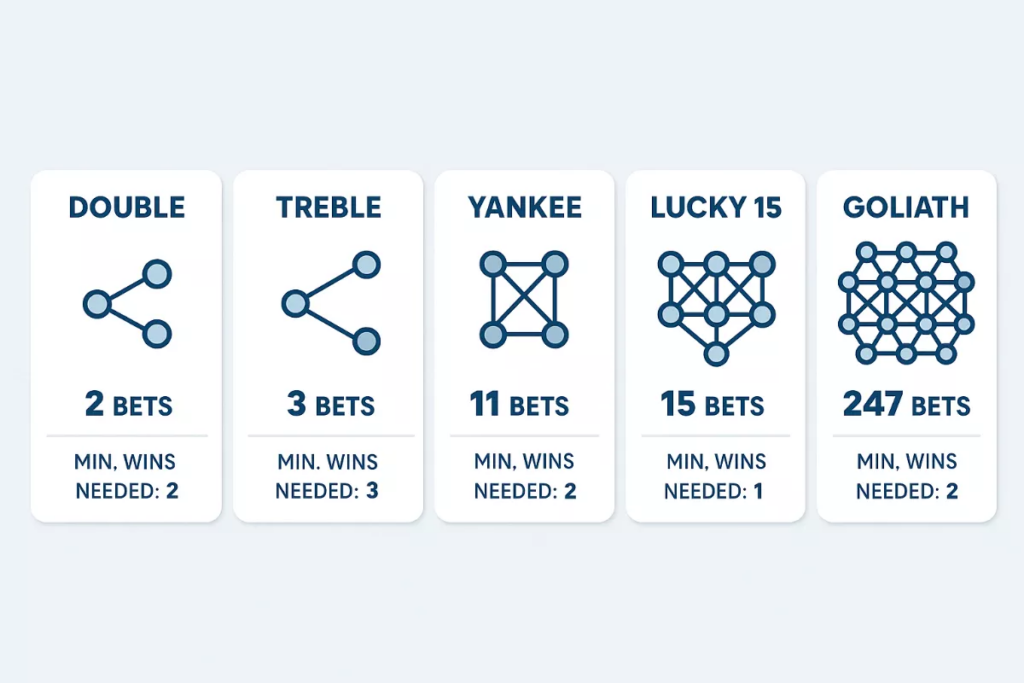
Standard accumulators are what we’ve been discussing so far. You select multiple outcomes, combine them into one bet, and need all selections to win. The naming convention is straightforward: two selections make a double, three create a treble, four form a four-fold accumulator, and so on. There’s technically no upper limit, though most bookmakers cap accas at around fifteen to twenty legs for practical and risk management reasons. The standard acca is all-or-nothing—one wrong selection and your entire stake disappears.
Each-way accumulators apply the each-way concept to multiple selections. In an each-way bet, half your stake goes on the selection to win and half goes on the selection to place (usually finishing in the top three or four positions, depending on the event). Each-way accas work the same way across multiple legs. They’re most common in horse racing, where you might back four horses each-way in different races. If all four win, you get full returns on both the win and place portions. If some win and others place, you still get returns on the place half. The trade-off is that each-way betting effectively doubles your stake, so a ten-pound each-way four-fold actually costs you twenty pounds total.
System Bets: Insurance Against Failure
System bets are where things get interesting for bettors who want some insurance against one or two legs failing. A system bet is essentially multiple accumulators combined together, covering different combinations of your selections. The most popular system bets have specific names and structures.
A Trixie consists of four bets across three selections: three doubles and one treble. At least two of your selections must win for any return. A Patent adds three singles to the Trixie, giving you seven bets total across three selections. You get returns if even one selection wins, though obviously the more selections that win, the better your return.
Move up to four selections and you can place a Yankee, which creates eleven bets: six doubles, four trebles, and one four-fold accumulator. Need at least two selections to win for any return. Add four singles to make a Lucky 15, giving you fifteen bets total. The “lucky” moniker comes from bookmakers often offering bonuses like double odds if only one selection wins, or consolations if all but one selection wins.
Five selections? That’s a Canadian or Super Yankee—twenty-six bets covering all possible combinations. Add singles and you’ve got a Lucky 31. Six selections create a Heinz (fifty-seven bets), seven selections make a Super Heinz (one hundred and twenty bets), and eight selections form a Goliath (two hundred and forty-seven bets). The names are memorable but the important thing to understand is that these massive system bets require substantial stakes because you’re effectively placing dozens or hundreds of individual bets simultaneously.
Important: System bets require substantial stakes because you’re effectively placing dozens or hundreds of individual bets simultaneously. A Lucky 15 with one-pound units means you’re actually staking fifteen pounds.
System bets appeal to bettors who like the structure of accumulators but want protection against one or two selections failing. The obvious trade-off is cost—placing a Lucky 15 with one-pound units means you’re actually staking fifteen pounds. The returns are also typically lower per selection compared to a straight accumulator because you’re hedging your risk across multiple combinations.
Bet builders represent a newer innovation that technically isn’t an accumulator in the traditional sense but feels similar in practice. A bet builder lets you combine multiple outcomes from the same event into one bet. You might build a bet on a football match that includes over 2.5 goals, both teams to score, a specific player to score, and over nine corners. The bookmaker multiplies these selections together to create combined odds, but the selections must be independent enough that one doesn’t make another significantly more likely.
The key difference between bet builders and traditional accas is that accas require selections from different events. You can’t include Manchester United to win and Manchester United to score first in a traditional acca because the second outcome partly depends on the first. Bet builders exist specifically to allow these correlated selections within a single match, though bookmakers carefully control which combinations they’ll price together.
Which type of accumulator should you actually use? That depends entirely on your goals and risk tolerance. If you’re chasing entertainment and the thrill of a big potential payout, standard accumulators deliver maximum excitement for minimum stake. If you want higher probability of some return and can afford the larger stake, system bets provide built-in insurance. If you’re deeply analyzing a single event and see multiple related outcomes you fancy, bet builders let you express that view.
What doesn’t work is randomly choosing different acca types without understanding their payout structures and failure modes. A bettor placing Lucky 15s every weekend without realizing they need three selections to win just to break even is burning money. Similarly, someone placing twenty-fold accas because they saw a social media post about a miracle winner is chasing outcomes so unlikely they might as well play the lottery.
The variety of accumulator types exists because different bettors have different preferences for risk, reward, and entertainment value. None of these bet types overcome the fundamental mathematical reality that bookmakers build their margin into the odds. But understanding the options at least lets you choose the structure that matches your actual betting objectives rather than stumbling into whatever the betting site promotes most heavily.
How to Place an Acca Bet: Step-by-Step Process
Placing an accumulator bet is mechanically simple, which is partly why they’re so popular. The challenge isn’t the clicking—it’s the thinking that should happen before you click. Let’s walk through both the technical process and the decision-making that separates random punts from considered wagers.
Start by opening your chosen bookmaker’s website or app and navigating to the sport you want to bet on. For this example, let’s use football since that’s where most accas get placed. You’ll see a list of upcoming matches with various betting markets available for each one. The most common acca selections come from match result markets (home win, draw, away win), but you can also build accumulators from markets like both teams to score, over/under goals, Asian handicaps, or first goalscorer bets.
Click on the outcome you want to back in your first selection. Let’s say Liverpool to win at home against Everton at odds of 1.65. That selection appears in your bet slip, usually located on the right side of the screen or accessible via a floating icon on mobile. The bet slip shows the selection, the odds, and a stake box where you’d normally enter how much you want to wager. Don’t enter a stake yet—you’re building an accumulator.
Move to your second match and select another outcome. Perhaps Manchester City to beat Brentford at 1.30. This selection also appears in your bet slip below the first one. Notice that the bet slip interface now shows multiple bet options: singles for each selection, a double combining the two, and depending on the bookmaker’s interface, possibly other combination bets.
Continue adding selections until you’ve built your desired accumulator. Let’s add Arsenal to win at 1.75 and Newcastle to win at 2.10. Your bet slip now displays four selections and should show you the combined accumulator odds—in this case, 1.65 × 1.30 × 1.75 × 2.10 equals approximately 7.84. Some bookmakers display these odds automatically once you have multiple selections; others require you to specifically choose “accumulator” from a dropdown menu or list of bet types.
Pre-Placement Checklist:
Before you enter your stake and confirm, check several important details. First, verify that all your selections are definitely what you intended. It’s surprisingly easy to accidentally click the wrong outcome, especially on mobile devices or when browsing quickly through long match lists. Second, confirm that all matches kick off at times you’re comfortable with. If you’ve inadvertently selected matches across three different days, you’ll be waiting days for your bet to settle, during which time anything could change—teams could rest key players, managers could get sacked, weather could turn awful.
Look at the combined odds and ask yourself honestly whether they reflect reasonable probability. Odds of 7.84 suggest roughly a 12-13% chance of all four outcomes occurring. Does that feel right based on your analysis? Or have you convinced yourself that four slightly uncertain outcomes magically become certain when combined? This reality check often gets skipped in the excitement of placing a bet, but it’s crucial for long-term discipline.
Check whether your accumulator qualifies for any promotions the bookmaker is running. Many sites offer acca insurance (stake refunded if one leg loses), acca boosts (enhanced odds or bonuses on winning accas), or other incentives. These offers usually have specific requirements like minimum number of selections, minimum odds per leg, or eligible sports and markets. If your acca qualifies, you’ll usually see a banner or notification on the bet slip. If it doesn’t qualify but you want it to, you might need to adjust your selections or add more legs.
Enter your stake amount. This is where discipline matters. Stake only what you’ve allocated for this bet within your overall betting bankroll. A common trap is seeing the potential return figure (stake multiplied by odds) and getting excited enough to increase your stake beyond what’s sensible. The bet slip will show your potential return—in this example, a ten-pound stake at 7.84 returns 78.40 pounds. That’s your total return including your stake back, so your profit would be 68.40 pounds.
Some bookmakers offer sliders or buttons for common stake amounts like five, ten, or twenty pounds. Others let you enter any amount down to their minimum (usually fifty pence or a pound). A few will show you what your return would be at different stake levels, which can be useful for planning but also dangerously tempting if you’re not disciplined.
Double-check everything one final time. Review each selection, confirm the odds, verify your stake amount, and make sure you understand what you’re betting on. This sounds tedious, but it takes literally five seconds and can save you from expensive mistakes. Once you’re satisfied, click the “Place Bet” button (sometimes labeled “Confirm Bet” or similar).
You’ll receive a bet confirmation screen showing a bet ID number, all your selections, the odds, your stake, and potential return. Many bettors screenshot this confirmation as a record, especially for larger stakes or longer accumulators. The bet is now active and will appear in your account’s open bets section.
Pro Tip
As your matches kick off and results come in, you can track your accumulator’s progress through your account. Most bookmakers show you which legs have won, which are in progress, and which are still upcoming. Some offer push notifications for significant moments like goals in matches you’ve bet on. Many provide a cash-out option, letting you settle the bet early at current market value if some legs have won and you want to secure profit or minimize potential loss.
The mechanical process of placing an accumulator is genuinely simple. The hard part—the part that actually determines whether you win money or lose it over time—is everything that happens before you click that final confirmation button. Choosing valuable selections, assessing realistic probabilities, managing your stake size, and recognizing when you’re chasing a fantasy rather than making a considered bet. The interface won’t stop you from making terrible decisions. That’s your job.
The Psychology of Acca Betting: Why Bettors Love (and Lose) Them
The popularity of accumulator bets has very little to do with their mathematical merit and everything to do with human psychology. We’re wired in ways that make accas incredibly appealing even when they’re objectively poor value. Understanding these psychological factors helps you recognize when your brain is sabotaging your better judgment.
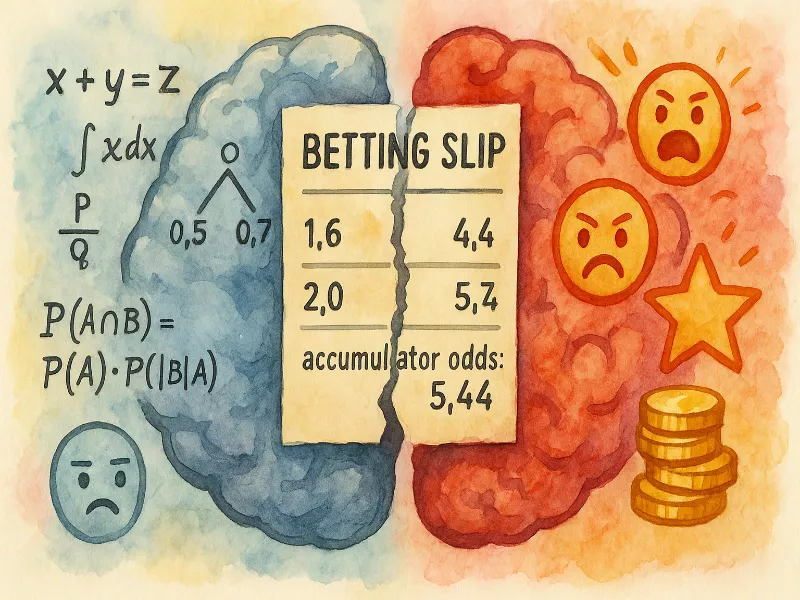
The big win fantasy sits at the core of acca appeal. Humans are notoriously bad at intuitively understanding probability, especially compound probability. We see ten-pound stake, hundred-pound return, and our brains focus entirely on the second number. The pathway from ten to one hundred feels tangible and achievable. We underweight the difficulty of everything going right and overweight the excitement of what happens if it does. This isn’t stupidity—it’s how human cognition evolved to work. We’re pattern-seeking creatures who naturally focus on potential rewards rather than probabilistic risks.
The near-miss effect devastates acca bettors emotionally. Having nine legs win and one leg lose feels absolutely gutting, far more painful than simply losing a normal bet. You were so close. Just one result different and you’d be counting your winnings. This near-miss scenario activates the same reward pathways in your brain as actually winning, which paradoxically makes you more likely to bet again rather than less. Slot machines exploit this exact same psychological vulnerability—the near-miss feels like progress even though mathematically it’s identical to any other loss.
Bookmaker Psychology: When you lose an accumulator, their interface often shows you exactly how close you came. “Nine out of ten won! Try again!” The implication is that you almost succeeded, you just got unlucky, and next time you’ll nail it. The reality is that ten-fold accumulators are designed to fail most of the time. Getting nine right isn’t “close”—it’s still a loss.
The entertainment value proposition is real but often misunderstood. Accumulators genuinely make watching sports more engaging. Having six matches running simultaneously with potential profit riding on all of them creates sustained excitement that single bets can’t match. This isn’t irrational if you’re consciously treating it as entertainment spending. Where it becomes problematic is when bettors convince themselves they’re investing or using strategy when they’re actually just paying for excitement.
Think of it this way: spending ten pounds to watch six football matches with heightened emotional investment might be perfectly reasonable entertainment spending. Spending fifty pounds every weekend chasing losses while telling yourself you have a system is not entertainment—it’s a problem. The line between these scenarios isn’t always obvious to the person on the wrong side of it.
Confirmation bias wrecks accumulator selection processes. You start with an outcome you want to happen—say, Manchester United to win—and then you subconsciously seek information that confirms that outcome rather than objectively assessing probability. You remember United’s last good performance while forgetting their terrible run before that. You note they’re at home while downplaying that they’re missing key players. You construct a narrative where your desired outcome feels inevitable, then you repeat this process for five more selections, and suddenly your six-fold acca feels like a solid bet when it’s actually six separate hopeful punts.
Sunk cost fallacy appears when bettors try to “chase” failed accumulators. You lose Saturday’s ten-pound accumulator, so Sunday you place another one trying to recover your loss. It fails too, so Monday you go bigger. This spiral continues because each loss makes you more desperate to justify the previous losses by eventually winning. The sunk cost fallacy is the mistaken belief that money already spent (and lost) somehow changes the value of future bets. It doesn’t. Each bet is an independent event with its own probability and expected value.
Social proof and FOMO drive massive amounts of acca betting. Someone in your friend group hits a big acca and won’t shut up about it. You see social media posts showing massive payouts from small stakes. Bookmakers advertise their biggest accumulator wins prominently. Suddenly you feel like you’re missing out on these success stories. What you’re not seeing is the hundreds of losing accas that each winner placed before hitting their lucky streak, or the thousands of other bettors whose accas failed that same weekend.
Survivorship bias is the statistical term for this phenomenon. You only hear about the successes. The failures aren’t newsworthy or social media worthy, so they remain invisible. This creates a distorted perception where winning accumulators seem more common than they actually are. It’s the same reason people overestimate the safety of air travel based on news coverage—crashes make headlines while thousands of safe flights every day go unmentioned.
The “due a winner” fallacy emerges after losing streaks. You’ve placed eight accumulators and lost all eight, so surely the ninth one is due to come in, right? This is the gambler’s fallacy—the mistaken belief that past independent events affect future independent event probabilities. If you flip a coin and get heads eight times in a row, the ninth flip still has exactly 50/50 odds. Your losing streak doesn’t make a winning acca more likely. Each accumulator stands alone with its own probability based on the specific selections and odds involved.
Variable ratio reinforcement is probably the most insidious psychological factor. This is a behavioral psychology concept where rewards delivered at unpredictable intervals create stronger behavioral conditioning than predictable rewards. Slot machines use this. Social media uses this. And accumulators absolutely use this. You might lose ten accumulators, then win one, then lose fifteen, then win two close together, then lose eight. This unpredictable pattern of wins keeps you engaged far more effectively than if you won or lost consistently. Your brain never quite learns to stop because the next win might be coming soon.
Self-Awareness Is Key
Understanding these psychological factors doesn’t make them stop working. Evolution built these cognitive patterns over millions of years—you can’t just turn them off. But conscious awareness helps. When you recognize the near-miss effect kicking in after a close loss, or when you catch yourself falling for the sunk cost fallacy, you can pause and reassess rather than immediately placing another bet.
The goal isn’t to become some perfectly rational betting machine. The goal is to notice when your psychology is pulling you toward decisions that conflict with your actual betting objectives and bankroll constraints.
Acca Bet Strategy: How to Build Smarter Accumulators

Let’s address the uncomfortable truth first: no strategy makes accumulator betting consistently profitable against bookmaker margins. If someone is selling you a system that guarantees acca profits, they’re either lying or don’t understand mathematics. That said, some approaches are significantly less bad than others, and understanding strategic principles helps you lose less money while maximizing entertainment value.
Keep Your Selection Count Reasonable
Keep your selection count reasonable. The biggest mistake casual acca bettors make is adding too many legs in pursuit of massive odds. Every additional selection exponentially reduces your win probability. A three-fold acca with carefully chosen selections gives you a realistic shot. A fifteen-fold acca is basically a lottery ticket. The sweet spot for most bettors falls between three and five selections. This range offers meaningful odds multiplication without pushing success probability into negligible territory. If you need more than five legs to hit your target odds, your target odds are too high for acca structure.
Focus on Value, Not Certainty
Focus on value, not certainty. Many bettors build accas by stacking heavy favorites, thinking that combining several “likely” outcomes creates a safe bet. This fails for two reasons. First, heavy favorites carry low odds that already account for their high probability—you’re getting poor value. Second, the bookmaker’s margin on favorites is often higher than on other markets, compounding your disadvantage. Instead of backing Manchester City at 1.15, Arsenal at 1.20, and Liverpool at 1.25, consider whether any of those prices actually represents value compared to your assessment of true probability.
Research Each Leg Independently
Research each leg independently. Lazy acca construction means scanning the fixture list and picking teams based on name recognition or gut feeling. Disciplined acca construction means analyzing each selection with the same rigor you’d apply to a single bet. What’s the team news? How have both sides performed recently? What’s the head-to-head record? Are there any tactical matchups that favor one side? This level of analysis requires time, which is why serious accas should be weekend specials rather than daily occurrences.
Stake Sizing for Accumulators
Limit your stake size appropriately. Accumulators should represent your most speculative betting activity, which means they should consume the smallest portion of your bankroll. If you’re staking 5% of your bankroll on single bets, your accas should be 1-2% maximum. The compounded risk deserves compounded caution with stake sizing. Many bettors do exactly the opposite—they stake conservatively on singles and then pile money onto accas because the potential returns look exciting.
Understand Market Correlation
Understand market correlation. Avoid building accas where selections influence each other. Backing several underdogs in the same league on the same day might seem like diversification, but if the league leader loses unexpectedly, it often indicates a day where favorites are struggling, making your other underdog selections more correlated than they appear. Similarly, weather conditions affect all matches in a region simultaneously. Professional bettors call this “correlation risk” and it destroys more accas than people realize.
Consider Each-Way Options for Long Shots
Consider each-way options for long shots. If you’re including longer-odds selections in your acca, each-way betting provides some cushion. This primarily applies to horse racing where each-way terms offer value, but the principle extends to other sports with place markets. The trade-off is doubling your stake, so you’re not getting free protection—you’re buying insurance at a cost. Only makes sense when the each-way terms are generous relative to the field size and true probability.
Use Acca Insurance Intelligently
Use acca insurance intelligently. Many bookmakers offer promotions where they refund your stake (usually as a free bet) if one leg loses but all others win. These offers add genuine value to your acca if you’re building one anyway. But don’t force yourself to place accas you wouldn’t otherwise place just because insurance exists. The insurance doesn’t change the fundamental mathematics—it just softens the psychological blow of near-misses. When insurance is available, structure your acca to maximize the chance of getting value from it by including one slightly riskier selection alongside safer picks.
Know When to Cash Out
Know when to cash out and when to let it ride. Cash-out features let you settle bets early at current market value. If three legs of your four-fold acca have won and the fourth match has a tight scoreline with ten minutes left, cashing out guarantees profit instead of risking complete loss. However, bookmakers price cash-out offers in their favor—you’re selling your position at below fair value. Cash out when securing profit meaningfully improves your overall bankroll situation. Don’t cash out reflexively because you’re scared or because the bookmaker is sending you push notifications encouraging it.
Track Your Results Honestly
Track your results honestly. Most acca bettors remember their wins vividly and forget their losses conveniently. This creates false confidence in their selection ability. Keep a simple spreadsheet logging every acca: date, selections, odds, stake, result, profit/loss. Review this quarterly. If you’re down significantly, accept reality and adjust your approach. If you’re somehow up (rare), analyze what you’re doing differently from typical acca bettors and maintain that discipline.
The Best Strategy
Recognize when not to bet. The best acca strategy is often no acca at all. If the weekend’s fixtures don’t offer several selections you genuinely fancy, don’t force it. Betting for the sake of betting is how bankrolls evaporate. The discipline to pass on weak betting opportunities separates recreational punters from serious bettors. You don’t need to have an acca running every weekend. You need to have your money available for genuine opportunities whenever they arise.
These strategic principles won’t transform you into a profitable acca bettor—the mathematics doesn’t allow for that against bookmaker margins. But they will help you make more considered decisions, reduce the worst mistakes, and ensure that whatever entertainment value you derive from acca betting comes at a reasonable cost relative to your bankroll and betting goals.
FAQ
What is an Acca bet?
An accumulator bet—commonly shortened to ‘acca’—is a single wager that combines multiple individual selections into one bet. The defining characteristic is simple: every single selection must win for your bet to pay out. There is no partial credit for getting most of it correct.
How do accumulator bets work?
Your stake and winnings from the first selection roll forward to become the stake on the second selection. Those combined winnings then roll forward again to the third, and so on. This progressive staking multiplies your odds, but if any single selection loses, the entire accumulated value is lost.
What types of accumulator bets are there?
There are standard accumulators (doubles, trebles, four-folds, etc.), each-way accumulators, system bets that provide insurance against failing legs (such as Trixie, Yankee, Lucky 15, and Goliath), and bet builders which allow you to combine multiple outcomes from the same event.
What is the best strategy for Acca betting?
To build smarter accumulators, keep your selection count reasonable (ideally between 3 and 5 legs), focus on value rather than certainty, research each leg independently, understand market correlation, strictly limit your stake size, and honestly track your results.