
How to Calculate Acca Odds: The Complete Mathematical Guide
 Available in US

Understanding how accumulator odds work isn’t just about plugging numbers into a calculator it’s about grasping why your tenner can turn into hundreds or why that seemingly safe five-fold bet has worse chances than you think. The mathematics behind acca betting determines everything: your potential returns, your actual probability of winning, and whether that attractive-looking bet slip represents value or a mathematical trap.
Most bettors glance at the combined odds their bookmaker displays, see a big number, and focus entirely on the potential payout. They skip the crucial step of understanding how those odds were calculated and what they actually mean in terms of probability. This guide strips away that mystery. You’ll learn how to manually calculate accumulator odds across different formats, understand what those calculations reveal about your true chances, and recognize when the mathematics is working for you versus when it’s working against you.
We’ll cover decimal odds multiplication (the easiest method), fractional odds conversion (for traditional UK bettors), and the relationship between odds and probability that determines your expected value. You’ll discover why bookmakers love when you don’t understand these calculations, learn how to spot the margin they’re building into your acca, and find out which free calculators actually work when you need them.
This isn’t about becoming a mathematician. It’s about developing enough numerical literacy to make informed betting decisions rather than hopeful guesses. By the end, you’ll be able to look at any accumulator and immediately assess whether the odds reflect reasonable probability or whether you’re chasing a fantasy dressed up in appealing numbers.
Table of Contents
- Understanding Betting Odds Formats: Your Foundation
- The Acca Odds Multiplication Formula: How It Actually Works
- Manual Calculation Versus Online Calculators: When to Use Each
- Calculating Potential Returns and Profit: What You Actually Win
- Implied Probability and Expected Value: The Advanced Perspective
- Common Calculation Errors and How to Avoid Them
Understanding Betting Odds Formats: Your Foundation
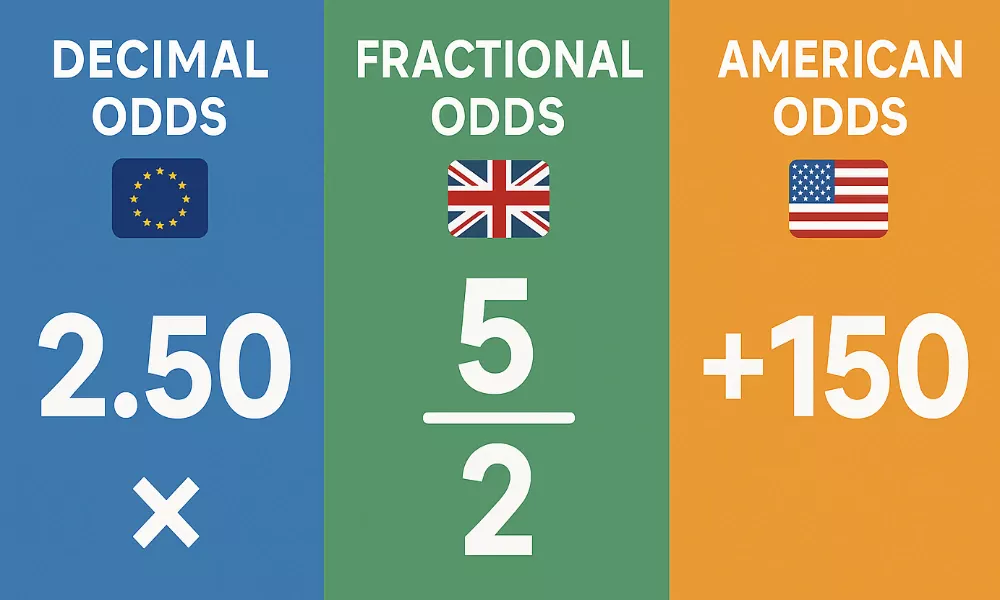
Before you can calculate accumulator odds, you need to understand the three main formats bookmakers use to express probability and potential returns. Each format conveys identical information but presents it differently, and some formats make acca calculations significantly easier than others.
Decimal odds are the international standard and by far the simplest for accumulator calculations. A decimal odd represents your total return for every unit staked, including your original stake. So odds of 2.50 mean that for every pound you bet, you get back two pounds fifty if you win that’s your original pound plus one pound fifty profit. Decimal odds below 2.00 indicate favorites (you risk more than you can win), while odds above 2.00 indicate underdogs (you can win more than you risk). The beauty of decimal odds for accas is that you simply multiply them together, no conversion needed.
Fractional odds are traditional in UK and Irish betting. They show your potential profit relative to your stake, expressed as a fraction. Odds of 5/2 (read as “five to two”) mean you profit five pounds for every two pounds staked. If you bet two pounds at 5/2 and win, you get back seven pounds total your two-pound stake plus five pounds profit. Fractional odds can be tricky for acca calculations because you need to convert them to decimal format first, otherwise the mathematics gets messy quickly.
American odds use positive and negative numbers to indicate underdogs and favorites. Positive odds show how much profit you make on a hundred-dollar stake, while negative odds show how much you need to stake to win one hundred dollars. So +200 means betting one hundred dollars wins you two hundred dollars profit, while -150 means you need to bet one hundred fifty dollars to win one hundred dollars profit. American odds are the most convoluted for accumulator calculations and almost always require conversion to decimal format unless you enjoy unnecessary complexity.
For accumulator calculations, decimal odds reign supreme. They make the multiplication process straightforward and intuitive. If you’re comfortable with fractional or American odds, that’s fine just convert them to decimal before doing your acca math. The conversion formulas are simple: for fractional odds, divide the first number by the second number and add one. So 5/2 becomes 2.5 divided by 1, which equals 2.5, then add 1 to get 3.5 in decimal. For American odds, if the number is positive divide 100 by the odds and add 1, if negative divide the odds by 100 and add 1. But honestly, most modern bookmakers display decimal odds with a single click, so let them do the conversion work for you.
The format matters less than understanding what the numbers actually represent. Odds are the bookmaker’s assessment of probability, adjusted to include their profit margin. Lower odds mean higher probability (as assessed by the bookmaker and betting market), higher odds mean lower probability. When you combine multiple selections into an accumulator, you’re multiplying probabilities together, which is why the odds multiply and why your chances of winning decrease exponentially with each added leg.
The Acca Odds Multiplication Formula: How It Actually Works
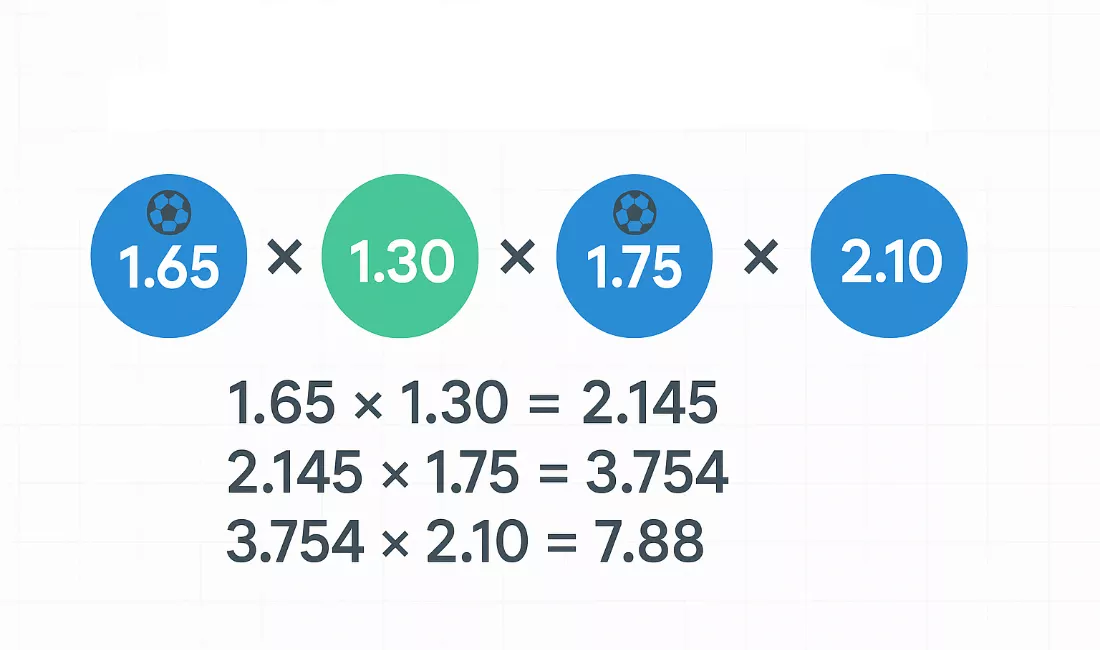
Calculating accumulator odds in decimal format is beautifully simple: you multiply all your individual odds together. That’s it. That’s the entire formula. The complexity comes from understanding what that multiplication means and catching the common mistakes bettors make in the process.
Let’s start with a concrete example using four football matches. You fancy Liverpool to beat Everton at odds of 1.65, Manchester City to beat Brentford at 1.30, Arsenal to beat Crystal Palace at 1.75, and Newcastle to beat Bournemouth at 2.10. To calculate your four-fold accumulator odds, you multiply these together: 1.65 times 1.30 times 1.75 times 2.10. Work through this step by step: 1.65 times 1.30 equals 2.145. Then 2.145 times 1.75 equals 3.75375. Finally, 3.75375 times 2.10 equals 7.8829. Round that to two decimal places and your accumulator odds are 7.88.
What does 7.88 mean in practical terms? If you stake ten pounds on this accumulator, you multiply your stake by the odds: ten times 7.88 equals 78.80. That’s your total return if all four selections win. Your profit would be 78.80 minus your original ten-pound stake, which equals 68.80 profit. Not bad from a tenner, assuming everything goes to plan.
The order of multiplication doesn’t matter mathematically you’ll get the same result whether you start with the shortest odds or the longest odds. But psychologically, some bettors prefer multiplying from shortest to longest odds because it creates a sense of building momentum. Others multiply from longest to shortest because they want to see the big number appear early. The result is identical either way, so choose whichever order makes intuitive sense to you.
Common mistakes in multiplication usually involve decimal points or rushing through the calculation. When multiplying odds by hand or mentally, it’s easy to misplace a decimal point and end up with odds that are ten times higher or lower than reality. This is why using a calculator is sensible for anything beyond a simple double or treble. Your phone has a calculator app use it. Getting the odds wrong means misunderstanding your potential return and your actual risk.
Another common error is including odds of 1.00 in your accumulator calculation. Some bettors building complex bet slips accidentally add selections that aren’t real bets maybe a placeholder or a mistake with odds of 1.00. Multiplying by 1.00 doesn’t change your odds at all, which means that selection is essentially pointless in your accumulator structure. If you see 1.00 anywhere in your odds multiplication, something has gone wrong with your bet construction.
The multiplication formula works identically regardless of how many selections you include. A double is two odds multiplied together. A treble is three. A ten-fold accumulator is ten odds multiplied together. The formula scales infinitely, though most bookmakers cap accumulators at fifteen or twenty legs for risk management reasons. The more selections you multiply, the higher your combined odds become, but also the lower your probability of winning becomes. That’s the fundamental trade-off in accumulator betting mathematics.
One thing the basic multiplication doesn’t show you is the bookmaker’s margin or your expected value. The odds multiply cleanly, but buried within each individual odd is the bookmaker’s profit margin. When you multiply odds together, you’re also compounding those margins, which is why bookmakers love accumulators. The margin accumulation effect means your combined odds don’t reflect true probability they’re skewed in the bookmaker’s favor, increasingly so with each additional selection.
Understanding the multiplication formula is your first step toward odds literacy. It lets you verify that your bookmaker’s bet slip is calculating correctly, helps you assess whether a potential return justifies your stake, and gives you the foundation for more advanced concepts like implied probability and expected value that we’ll cover next.
Manual Calculation Versus Online Calculators: When to Use Each
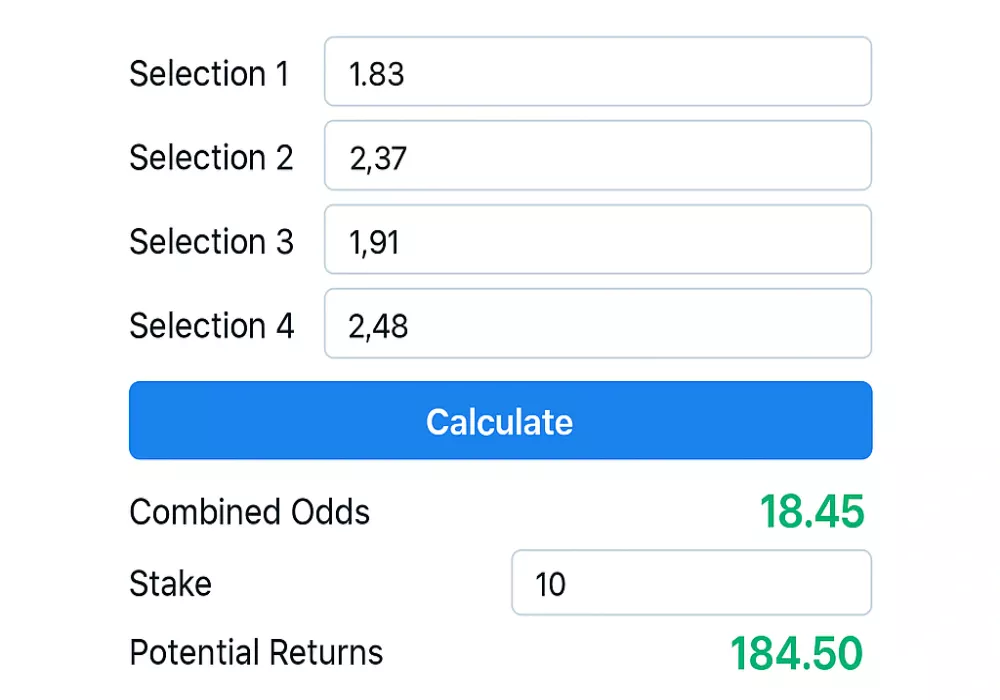
You have two options for calculating accumulator odds: doing the math yourself or using an online calculator. Both approaches have merit in different situations, and understanding when to use each makes you a more efficient and informed bettor.
Manual calculation is best for simple accumulators with clean decimal odds. If you’re building a treble or four-fold with odds like 2.00, 1.50, and 1.75, you can multiply these in your head or with a basic calculator in seconds. Mental math for simple accas keeps you engaged with the numbers and helps you develop intuitive understanding of how odds multiplication works. It also means you’re not dependent on internet access or specific websites when you want to quickly assess a potential bet.
The process for manual calculation is straightforward. Take your first two odds and multiply them together. Then take that result and multiply it by your third odds. Continue this pattern until you’ve multiplied all your selections. For a four-fold acca at 2.00, 1.80, 2.20, and 1.60, start with 2.00 times 1.80 equals 3.60. Then 3.60 times 2.20 equals 7.92. Finally, 7.92 times 1.60 equals 12.672, which rounds to 12.67. Your four-fold accumulator has combined odds of 12.67. If you stake ten pounds, you multiply ten by 12.67 to get 126.70 total return, meaning 116.70 profit if all four legs win.
Online calculators become valuable when you’re dealing with awkward decimal odds, many selections, or different bet types like each-way accumulators or system bets. If your odds are something like 1.83, 2.37, 1.91, 2.48, and 1.67, manual calculation gets tedious and error-prone. Plugging these into an accumulator calculator takes seconds and eliminates the risk of mathematical mistakes. Most quality calculators also show you potential returns at different stake amounts, which helps with planning.
The best free accumulator calculators are typically provided by major bookmakers or independent betting information sites. Bet365, William Hill, and Paddy Power all offer acca calculators that are simple to use and accurate. Independent sites like AceOdds and OddsMonkey provide more sophisticated calculators that handle various bet types including system bets like Yankees and Lucky 15s. These calculators usually ask you to input your odds format preference, number of selections, individual odds, and stake amount, then instantly display your combined odds and potential returns.
When using online calculators, verify the results make intuitive sense. If you input four selections with odds around 2.00 each and the calculator spits out combined odds of 500.00, something went wrong likely a decimal point error in your input. Similarly, if you input odds for a ten-fold accumulator and get combined odds of 3.00, you’ve probably made a mistake because multiplying ten sets of odds should produce a substantially higher number unless they’re all extreme favorites.
Some calculators offer additional features like implied probability displays, expected value calculations, or the ability to adjust for bookmaker promotions like odds boosts. These advanced features are useful if you’re serious about betting strategy, but they’re not necessary for basic odds calculation. The core function multiplying your odds together and showing potential returns is what matters most.
One crucial thing calculators can’t do is tell you whether a bet is worth placing. They’ll accurately calculate your odds and potential returns, but they won’t assess value, analyze team form, or determine if the odds reflect reasonable probability. Calculators are tools for numerical computation, not decision-making. You still need to do the analytical work of deciding which selections deserve to be in your accumulator.
For each-way accumulator calculations, online calculators become almost essential unless you’re comfortable with complex multiplication across win and place returns. Each-way accas require calculating two separate accumulators one for the win part at full odds and one for the place part at reduced odds then combining them. This quickly becomes complicated enough that manual calculation invites errors. Let the calculator handle it.
The ideal approach combines both methods strategically. Use mental math or basic calculator work for simple accumulators to stay numerically engaged and develop intuition. Use online calculators for complex accas, unusual odds, or when you want to quickly compare different combinations of selections. Neither method is superior in all situations they’re complementary tools that serve different purposes in your betting workflow.
Calculating Potential Returns and Profit: What You Actually Win
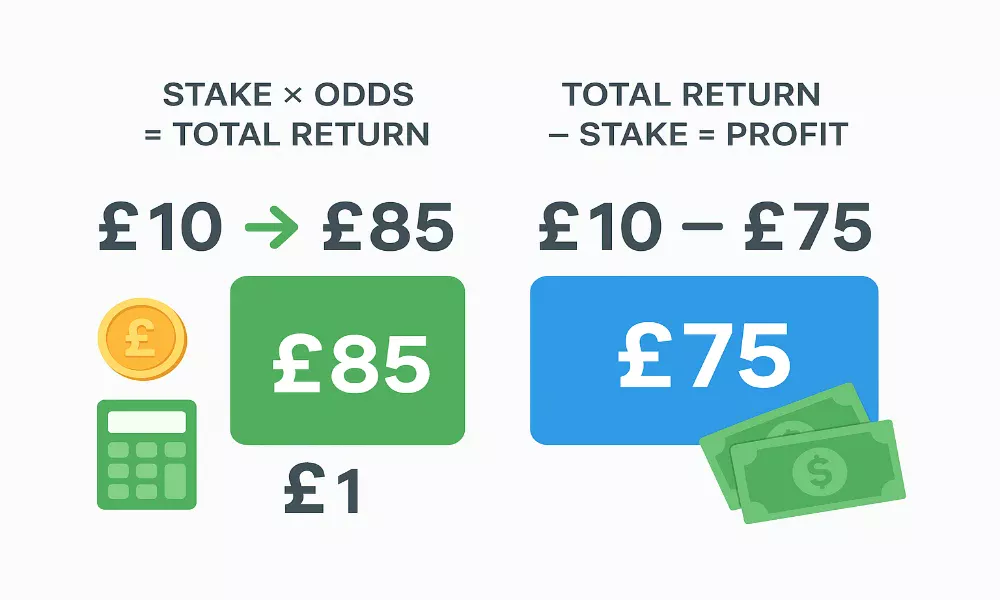
Understanding combined odds is one thing, but translating those odds into actual money in your pocket requires knowing how to calculate returns and profit. These concepts sound similar but represent different things, and confusing them leads to disappointing surprises when your bet wins.
Your total return is your stake multiplied by your combined odds. This is the total amount of money the bookmaker pays you if your accumulator wins. It includes both your original stake being returned and your profit. So if you stake ten pounds at combined odds of 8.50, your total return is ten times 8.50, which equals 85 pounds. That entire 85 pounds is what appears in your account balance after your winning bet settles.
Your profit is your total return minus your original stake. This is the actual money you’ve gained from the bet. Using the same example, if your total return is 85 pounds and your stake was ten pounds, your profit is 85 minus 10, which equals 75 pounds. That’s the money you can withdraw or use for future bets without touching your original betting bankroll.
The distinction matters because bettors sometimes look at combined odds and think “I’m getting 8.50 on my money,” which is true in terms of multiplier but misleading in terms of profit. You’re not making 8.50 times your stake in profit you’re making 7.50 times your stake in profit because one unit of that return is just your original stake coming back. This might seem pedantic, but it affects how you assess value and manage your bankroll.
For fractional odds thinkers, this distinction is more intuitive because fractional odds explicitly show profit relative to stake. Odds of 7/1 mean you profit seven pounds for every pound staked, and you also get your stake back, so your total return is eight pounds per pound staked. Decimal odds of 8.00 represent exactly the same thing, but the calculation structure makes it less obvious that one unit of your return is stake repayment.
When calculating profit across multiple stakes or comparing different bet types, always work with profit figures rather than total returns. If you’re deciding between a ten-pound accumulator at 8.00 (70 pounds profit) and five two-pound accumulators at 4.00 each (30 pounds profit on each if all win, 150 pounds total profit if all five somehow win), you need to compare profit potential, not just look at the bigger combined odds number.
Bookmaker interfaces usually display both total return and profit on your bet slip before you confirm your wager. Double-check these numbers match your own calculations. If you calculate a potential profit of 75 pounds but the bet slip shows 85 pounds, you’ve probably confused total return with profit. If the numbers differ significantly from your calculations, you might have misread the odds, made a multiplication error, or the bookmaker might be applying a promotion that adjusts your odds.
For each-way accumulator returns, calculations become more complex because you need to determine win returns and place returns separately, then combine them based on what actually happens in your selections. If you place a ten-pound each-way four-fold (which is actually a twenty-pound total stake ten pounds on the win accumulator and ten pounds on the place accumulator), your returns depend on how many selections win versus place. All four winning gives you returns on both accumulators. Three winning and one placing gives you reduced returns from the place accumulator only. This is where online calculators become valuable, as the conditional logic gets complicated quickly.
System bet returns are even more complex because you’re calculating returns across multiple smaller accumulators simultaneously. A Yankee with eleven bets means potentially eleven different payouts depending on how many of your selections win. Rather than manually calculating each permutation, use a system bet calculator that handles the conditional mathematics. What matters is understanding conceptually that system bets pay out on partial success, whereas standard accumulators are all-or-nothing.
The key principle across all these calculations is transparency. You should always know exactly how much you’re risking, what your potential return looks like if you win, and what your actual profit will be. If those numbers aren’t clear before you place your bet, don’t place the bet. Confusion about returns is how bettors accidentally stake more than they intended or misunderstand the risk-reward profile of their wagers.
Implied Probability and Expected Value: The Advanced Perspective
Once you understand how to calculate odds and returns, the next level of sophistication involves understanding what those odds actually mean in terms of probability and value. This is where casual bettors and serious bettors diverge the serious ones assess whether the odds offered represent genuine value compared to true probability.
Implied probability converts odds into percentage chance of the event occurring. The formula for decimal odds is simple: divide 100 by the odds. So odds of 2.00 have an implied probability of 100 divided by 2.00, which equals 50 percent. Odds of 4.00 imply 25 percent probability. Odds of 1.50 imply 66.67 percent probability. This calculation shows you what the bookmaker’s odds suggest about how likely an outcome is to happen.
For accumulator betting, you calculate implied probability for the entire acca the same way divide 100 by your combined odds. If your four-fold accumulator has combined odds of 8.00, the implied probability is 100 divided by 8.00, which equals 12.5 percent. That means according to the bookmaker’s odds, your accumulator has a 12.5 percent chance of all four legs winning. Or to flip that perspective, an 87.5 percent chance of at least one leg failing.
Understanding implied probability helps you reality-check your accumulators. If your five-fold acca has combined odds of 25.00, the implied probability is just 4 percent. Does your accumulator genuinely have a 4 percent chance of success? Or have you convinced yourself that five reasonably likely outcomes will all happen simultaneously when the mathematics says that’s actually quite improbable? Implied probability forces you to confront the numerical reality behind the attractive odds.
The bookmaker’s margin or overround is built into these probabilities. If you calculate implied probabilities for all possible outcomes in a market and add them together, they total more than 100 percent. That excess is the bookmaker’s profit margin. For a simple match with three outcomes, the implied probabilities might total 105 percent or 108 percent. That extra 5-8 percent is where the bookmaker makes their money. When you combine multiple selections into an accumulator, these margins compound, giving the bookmaker an even larger edge.
Expected value takes this further by comparing implied probability to true probability to determine if a bet offers positive or negative value. If you believe a selection has a 30 percent chance of winning but the odds imply only a 25 percent chance, that’s a value bet the odds are better than they should be relative to true probability. If you believe a selection has a 20 percent chance but odds imply 25 percent, that’s negative value the odds are worse than they should be.
For accumulators, calculating expected value becomes complex because you need to assess true probability for each individual selection, multiply those probabilities together to get your overall acca probability, then compare that to the implied probability from the bookmaker’s odds. Most bettors skip this step entirely, which is partly why bookmakers love accas people focus on potential returns rather than probability-adjusted value.
A simplified expected value assessment for accumulators works like this: estimate each selection’s true probability of winning. Multiply those probabilities together to get your accumulator’s overall probability. Convert that to decimal odds by dividing 100 by your probability percentage. Compare those odds to what the bookmaker is offering. If the bookmaker’s odds are higher, you might have a value bet. If they’re lower, you’re taking negative expected value.
For example, you build a four-fold acca where you assess true probabilities as 70 percent, 65 percent, 75 percent, and 60 percent for each leg. Multiply these together: 0.70 times 0.65 times 0.75 times 0.60 equals 0.20475, or about 20.5 percent overall probability. Convert to decimal odds: 100 divided by 20.5 equals 4.88. If the bookmaker offers you odds of 5.50 on this acca, that’s potentially positive value. If they offer 4.20, you’re taking a negative value bet.
The challenge is accurately assessing true probability, which is incredibly difficult even for experts. Your subjective assessment of a team’s chances is filtered through biases, incomplete information, and the fundamental uncertainty of sport. This is why expected value analysis works better as a framework for thinking than as a precise calculation. It helps you ask the right questions am I getting good odds for the risk? Does this acca offer value or am I chasing big numbers? even if you can’t answer them with mathematical precision.
Most recreational acca bettors can safely skip expected value calculations and focus on implied probability instead. Just understanding that your five-fold acca at 20.00 has only a 5 percent implied chance of winning is valuable information. It grounds your expectations and helps you recognize when excitement is overriding probability assessment. If you’re comfortable with more advanced mathematics and want to take betting seriously, expected value becomes your primary decision-making framework, but it requires significant practice and disciplined record-keeping to apply effectively.
Common Calculation Errors and How to Avoid Them
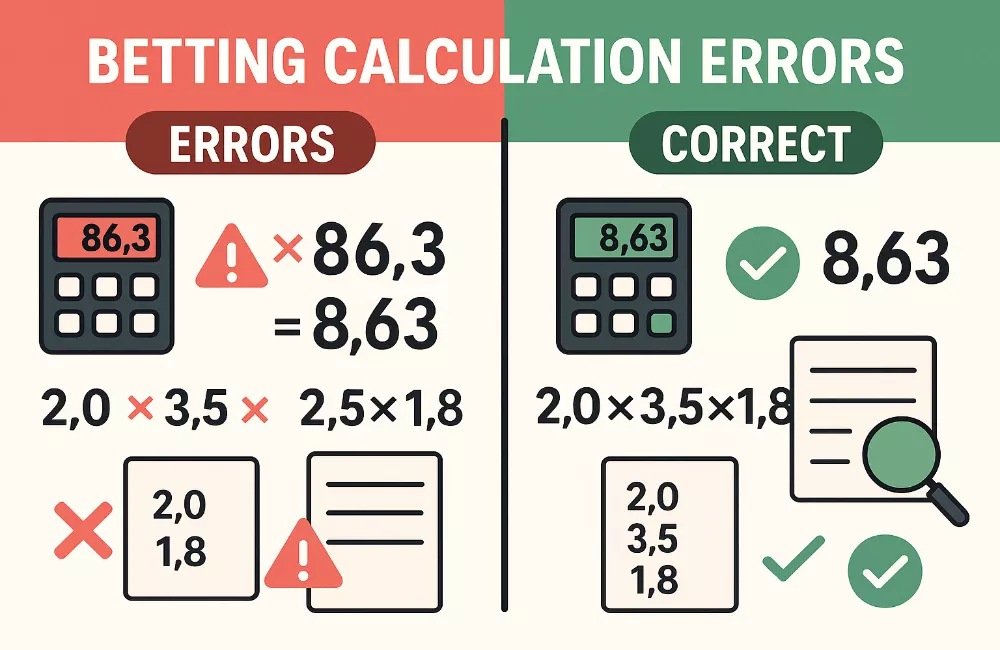
Even simple mathematics invites errors when money and emotion are involved. Understanding the common mistakes bettors make when calculating acca odds helps you avoid expensive miscalculations and builds confidence in your numerical decision-making.
The single most common error is misplacing decimal points during multiplication. When you multiply 1.83 by 2.47 by 1.91, it’s easy to lose track of where decimals belong, especially if you’re doing mental math or using a basic calculator quickly. You might end up with odds of 86.3 instead of 8.63, leading you to believe your ten-pound stake returns 863 pounds when it actually returns 86.30. This error usually gets caught when you see the bet slip display a much smaller return than you expected, but by then you might have made staking decisions based on inflated expectations.
The solution is simple: slow down. Take an extra three seconds to verify your decimal points are in the right place. Use your phone’s calculator app instead of trying to multiply complex decimals mentally. Check your calculated odds against what the bookmaker’s interface displays if there’s a significant discrepancy, you’ve made a mistake somewhere.
Another frequent error involves forgetting to include all selections in your calculation. You’re building a five-fold accumulator, calculate odds for four legs, see an attractive number, and place your bet without multiplying in the fifth selection’s odds. This leads to surprise when your returns are different than expected. The prevention is methodical checking: count how many selections are on your bet slip, count how many odds you multiplied together, verify they match.
Some bettors make the mistake of adding odds instead of multiplying them. This stems from misunderstanding how accumulator mathematics work. If you have three selections at 2.00 each and you add the odds, you get 6.00. But accumulator odds multiply, so you should get 2.00 times 2.00 times 2.00, which equals 8.00. Adding gives you significantly lower odds than you should have, though this error usually gets corrected when you check against the bookmaker’s calculation. Still, understanding that multiplication is the correct operation prevents confusion.
Incorrectly converting between odds formats causes problems when you’re working with mixed formats. If you convert fractional odds to decimal and make an error say, treating 5/2 as 2.50 instead of 3.50 that mistake propagates through your entire accumulator calculation. Always double-check conversions, and when possible, let the bookmaker’s interface do the format conversion for you rather than doing it manually.
Rounding too aggressively during intermediate steps can lead to errors in final odds. If you’re calculating a long accumulator by hand and you round each intermediate result to one decimal place, those small rounding errors compound and your final odds might be noticeably different from the precise calculation. If you need to round, round only at the final step, or better yet, use a calculator that maintains full precision throughout the calculation.
Some bettors confuse combined odds with individual odds when they’re switching between singles and accumulators quickly. You calculate that a four-fold has odds of 7.50, then later you remember “7.50” but forget whether that was one leg or the combined odds, leading to staking errors. Keep clear notes when you’re evaluating multiple betting options simultaneously, or use the bet slip as your single source of truth rather than trying to remember numbers in your head.
Failing to account for each-way terms is a specific error for each-way accumulators. You calculate win odds correctly but forget that place odds are typically a quarter or a fifth of win odds, leading you to overestimate your potential place returns. Always verify what the each-way terms are for your specific bets they vary by sport and event and factor them into your calculations properly or use an each-way calculator.
The overarching solution to all these errors is developing a systematic checking process. Before you confirm any accumulator bet, verify that you understand the combined odds, that those odds match your own calculation or make intuitive sense, that you know what your potential return and profit will be, and that your stake size is what you actually intended. This takes perhaps ten seconds of focused attention, but those ten seconds can save you from costly mistakes that undermine your entire betting strategy.
Mathematics in betting isn’t about being a genius calculator. It’s about being careful, methodical, and honest with yourself about what the numbers actually say. Most calculation errors come from rushing, from wishful thinking that overrides careful checking, or from not understanding the basic formulas. All of these are fixable with practice and discipline. The more comfortable you become with odds calculation, the faster and more accurate your process becomes, until checking your mathematics is as automatic as checking the time before leaving the house.
After learning how accumulator odds are calculated and how multiple selections combine to produce final bet payouts, readers can always return to the acca-bet to continue exploring the broader educational content on the site.
If you want to understand how these calculations interact with risk management tools offered by bookmakers, it is also useful to read the article acca insurance guide, which connects the theory with a practical betting feature.
Expertly verified: Oliver Bennett